New Grid Services Group: What It Means for UK Electricians
BEAMA has launched a grid contractors group with United Infrastructure, Balfour Beatty and M Group. What it means for UK electricians, jointers and apprentices.
Here's a piece of grid news that sounds dry on paper but matters a lot if you want a long career in network work. On 29 October, the trade body BEAMA launched a new Electricity Networks Infrastructure (ENI) Services Group, and IN Power reported it on 2 November. For the first time, the contractors who actually build Britain's grid have their own seat at the table where the next decade of network investment is being planned.
Why should an electrician, jointer or apprentice care about a trade association committee? Because the firms in this group are the ones doing the hiring, and the group's first priority is the workforce. Let me explain.
What's been announced
According to BEAMA's announcement, the ENI Services Group represents services companies delivering grid infrastructure: civil engineering, construction, design, specification and wider services. Until now BEAMA mainly represented the manufacturers and suppliers of grid equipment. This group brings the delivery side in alongside them.
The founding line-up is serious:
- United Infrastructure chairs the group through Griff Thomas, its executive director of energy transition.
- Balfour Beatty, through its Power Transmission and Distribution business.
- M Group, through its electricity infrastructure operations.
The group gives these firms a direct route into the Electricity Networks Growth Partnership, which BEAMA and the Energy Networks Association (ENA) set up to deliver the new Electricity Networks Sector Growth Plan. BEAMA says its priorities are building the workforce, shaping procurement rules and standards, and giving the supply chain a clearer view of future work. BEAMA and the founders are also inviting other services firms to join.
Griff Thomas summed up the thinking: "A contractor's perspective is critical if the UK is to deliver this infrastructure as efficiently as possible. By bringing leading delivery partners together, we will have a single voice on policy and regulation, so we can shape it rather than just be on the receiving end of it."
The plan behind it: £181bn and 71,000 people
The group exists to help deliver the Electricity Networks Sector Growth Plan, published on 20 October by BEAMA and the ENA. The headline numbers, as reported by Construction News and BEAMA:
- £181bn of investment by network operators in Great Britain's electricity networks by 2035.
- More than 210,000 jobs supported across the sector and its supply chain.
- £58bn for the UK economy.
(You may have seen a "£200bn" figure in our earlier look at the plan. The ENA's launch release talks about network operators and their supply chain investing up to £200bn over ten years, while £181bn is the network operators' figure to 2035. Either way, it's a lot of copper and steel.)
The workforce research behind the plan was led by Energy & Utility Skills, and it's the bit I'd pin on the van wall:
- The electricity networks sector directly employs around 90,000 people today.
- That could grow to 117,000 to 124,000 by 2035. Under the report's main scenario, that's about 27,000 additional direct jobs.
- Around 21,000 people are expected to retire over the period, and another 23,000 to leave through normal turnover.
- Put together, the sector needs to attract, recruit, train and retain around 71,000 people into its direct workforce by 2035.
- Construction and installation is the fastest-growing slice, projected to more than double from around 18,000 to 37,000 people, up 106%.
- Around 6,000 apprenticeship starts could be needed over the decade.
I like that IN Power was careful about this: the 71,000 figure is growth plus replacement, not 71,000 brand-new posts. That's an honest number, and honestly it's still a great one. Retirements mean experienced roles opening up, and the people stepping into them will be the ones who started building their HV skills now.
Why a contractors' group matters for your career
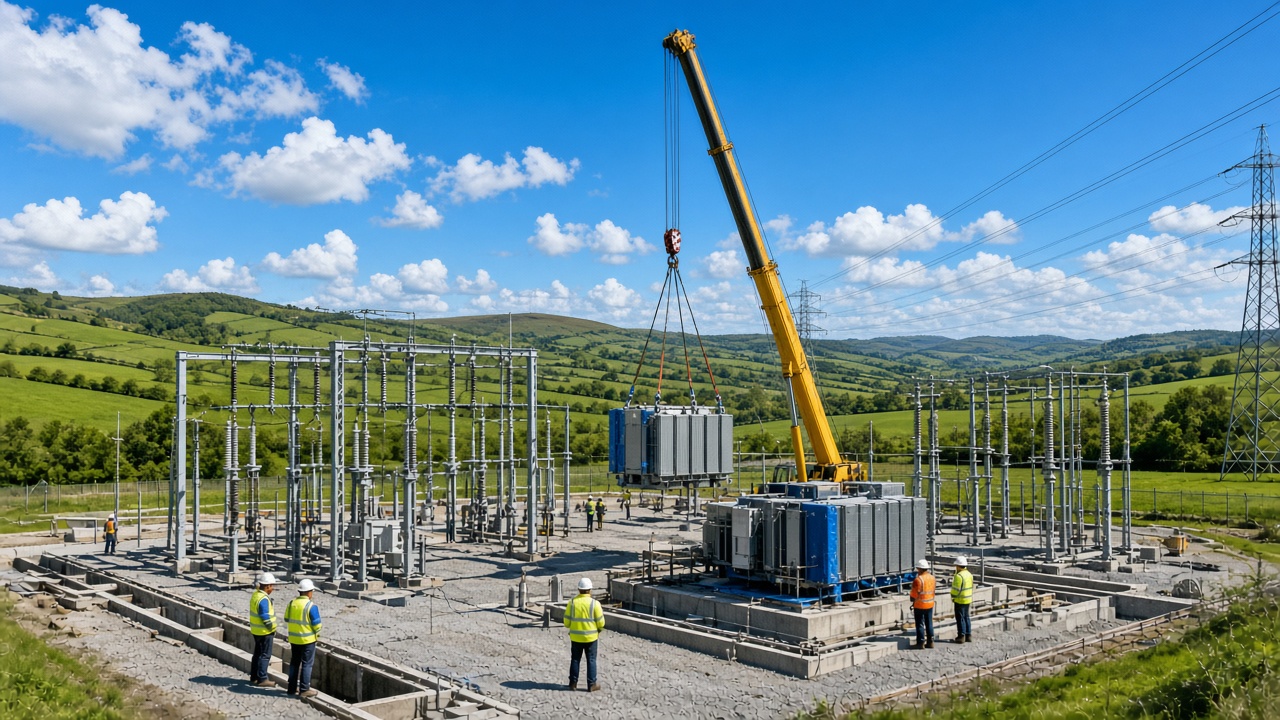
Network operators own the grid, but contractors build a large share of it. IN Power's write-up gives a good feel for the work: substation construction combining civil engineering, HV equipment installation, electrical connections and commissioning; transformers, switchgear, protection and control equipment installed to the network operator's specifications; and cable projects needing route preparation, cable jointing and high-voltage testing. It also notes that cable installation, electrical testing, switchgear work, protection commissioning and safe isolation all depend on the right training and authorisation.
That's exactly where the shortage bites, and exactly where this group wants to act. BEAMA says the group will help develop a national training programme with its existing members. The Energy & Utility Skills action plan also calls for centralised training for network-critical professions and more consistent standards to make it easier to move between employers.
The other priorities sound boring but help you too. Clearer pipelines and procurement reform let contractors commit to hiring and training ahead of demand rather than scrambling contract by contract. Standardisation, where sensible, means the skills and procedures you learn on one network transfer more easily to the next. More certainty for employers usually means more permanent roles, more apprenticeships and more investment in people.
Andy Smith, managing director for distribution and EV at M Group, put the upside nicely: the growth "brings a shared challenge but also a fantastic opportunity to create and shape lifelong careers in an exciting industry, including for many young people looking to make that first step."
What it means for you
If you're a qualified electrician in commercial, industrial or maintenance work, you're closer to network work than you think. The ENA's release says around 80 major transmission projects will be delivered by 2030, alongside major reinforcement of local distribution networks, and networks will need to support more than 2.3 million new homes and around 1,800 EV charging hubs by 2035. Distribution and EV connection work is a natural bridge. Highlight your test, isolation and fault-finding experience, and look at the big delivery contractors as well as the DNOs.
If you're a cable jointer, you're in one of the trades the plan leans on hardest. The JIB already recognises the trade in its grading, with Approved Jointers on the same hourly rate as Approved Electricians: £21.19 an hour on own transport in 2026, per the JIB Handbook. Many network roles sit under other agreements and pay differently, so always compare offers. Our HV cable jointer guide covers the voltage ladder and how to climb it.
If you're a substation fitter or want to be one, the doubling of construction and installation roles is your headline. IN Power notes that the availability of people with switchgear, protection commissioning and safe isolation skills limits how many projects can run at once, and authorisation (AP and eventually SAP) is where careers tend to step up. See our guides to the substation fitter and Senior Authorised Person roles.
If you're starting out, 6,000 apprenticeship starts over the decade is a real pipeline. Look at the delivery contractors as well as the network operators, and check out routes like the Sector Entry programme we covered last week.
If you run a contracting business, this is worth watching closely. BEAMA is actively inviting other services firms to join, and the group will feed into procurement and standards discussions that shape how work is packaged and let. Even if you don't join, clearer visibility of future work is exactly what an SME needs before it takes on another apprentice or buys new kit.
Practical steps this month
- Get your safety and isolation credentials in order. Network employers care a lot about safe systems of work. Keep your ECS card and any HV training records current.
- Target the delivery side. Search for roles with the big infrastructure contractors and their subcontractors, not just the network operators.
- Talk in their language. On your CV, mention switchgear, protection, testing, jointing or commissioning experience specifically, with voltages where relevant.
- Ask about training up front. With a 71,000-person gap to fill, it's fair to ask any network employer what training and authorisation pathway they offer.
- Use the tools. AI assistants such as Grok Bot, Claude or ChatGPT can help you tailor a CV to a network job spec or explain unfamiliar terms in a job advert. Then check the detail with the employer.
My take
I love seeing this. A grid upgrade on this scale is only as good as the people who build it, and the contractors who employ those people now have a formal voice in how it's delivered. Workforce first, training programmes, clearer pipelines: that's the right order of priorities. If you've ever thought about moving into network work, the door is opening wider than it's been in a generation.
Ready to plug in? Browse grid, substation and electrical jobs across the UK and Europe on ElectricalRoles.co.uk.