What Does an EV Charge Point Installer Do? UK Pay and Routes In
What an EV charge point installer does, the 2921 and BS 7671 A4 rules, OZEV status, real UK pay data and practical steps to break into EV charging work.
Ten years ago, fitting an EV charger was a curiosity job you might do once a quarter for an early adopter with a shiny new EV on the drive. Today it's a mainstream trade specialism, and in my view one of the best entry points into the electrified future for any qualified spark. There are now more than two million electric vehicles on UK roads, the public network has passed 120,000 chargers, and every one of those needed someone competent to survey, install, test and commission it.
This is the next guide in our "What does X do?" series. Here's what an EV charge point installer actually does, what qualifications you need, what the job really pays (with sources, not guesses), and how to break in.
What the job actually involves
At its simplest, an EV charge point installer designs, fits, tests and commissions the equipment that charges electric vehicles. In practice, the work splits into two quite different worlds.
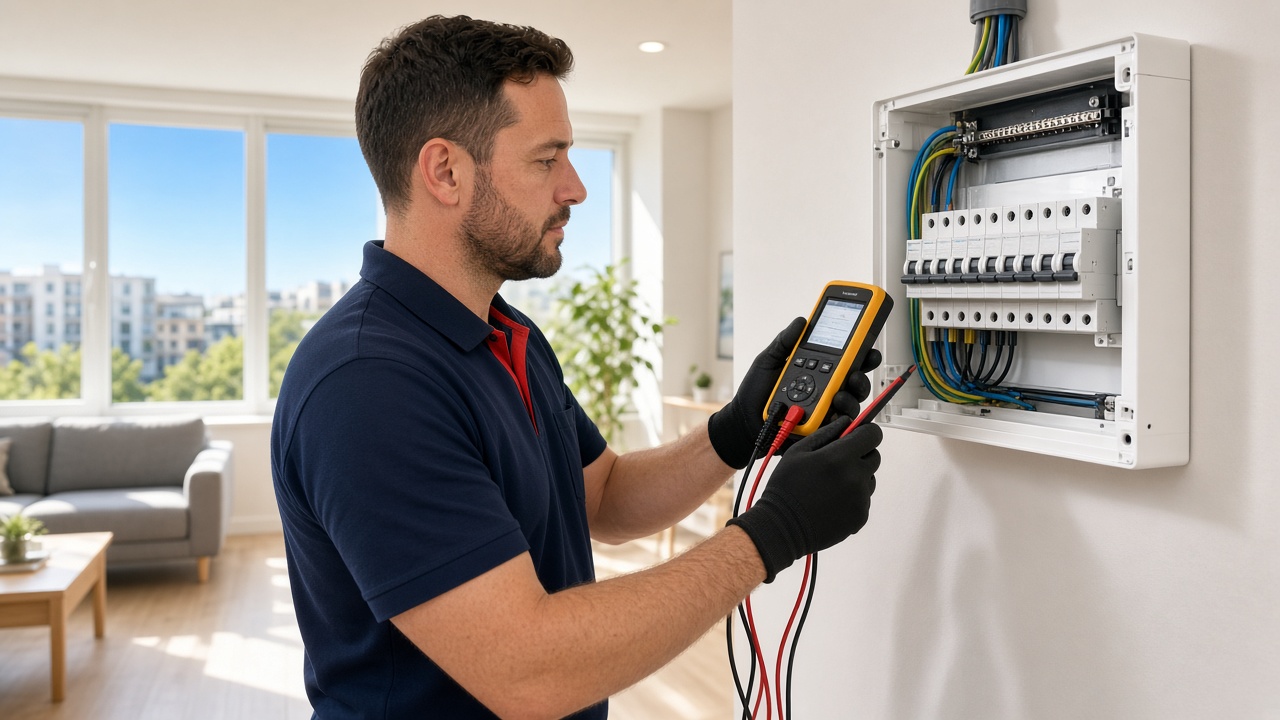
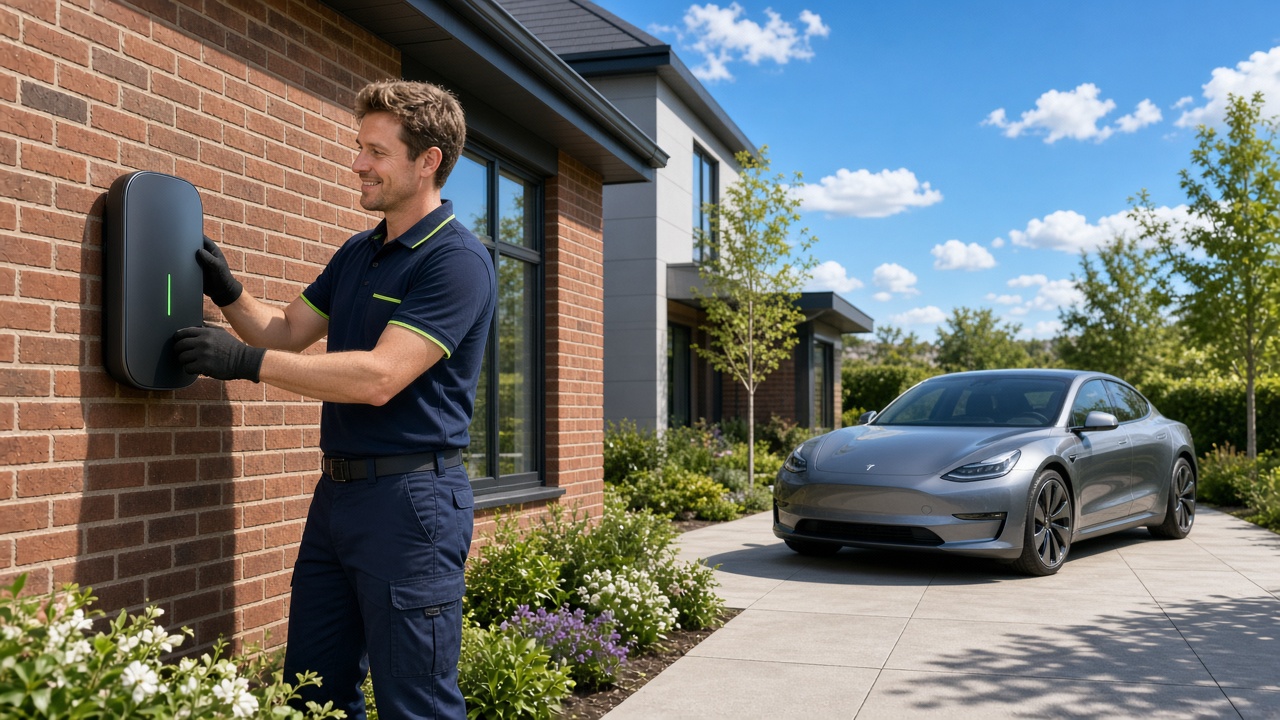
Domestic and small commercial. This is the 7kW wallbox on a driveway, a pair of chargers for a small business car park, or a landlord fitting points across a block of flats. A typical day might be two installs. Each starts with a survey: checking the incoming supply and main fuse, working out maximum demand, assessing the earthing arrangement and choosing a cable route. Then you mount the unit, run and terminate the supply, fit protection, connect it to the customer's app and Wi-Fi, test and certify. You'll issue a BS 7671 Electrical Installation Certificate and notify the distribution network operator (DNO). Much of the skill is in the survey and the conversation. Customers want a neat job and a clear explanation of what happens when the car, heat pump and oven all run at once.
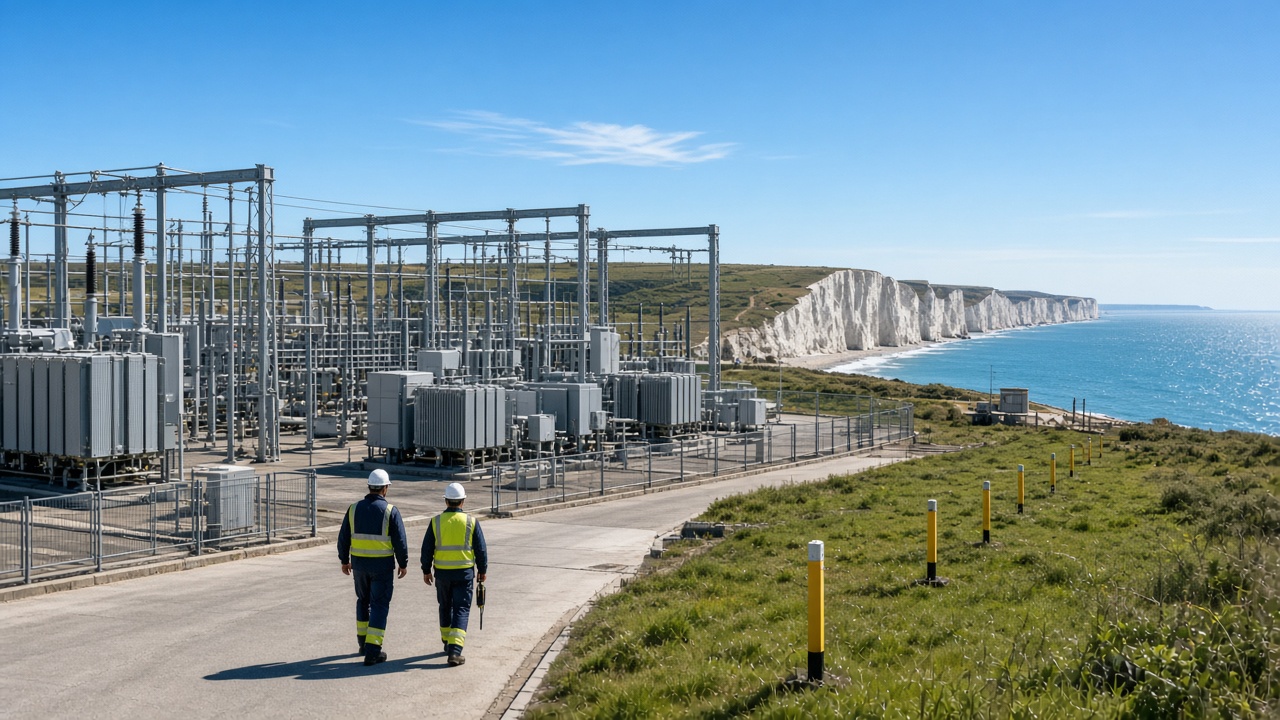
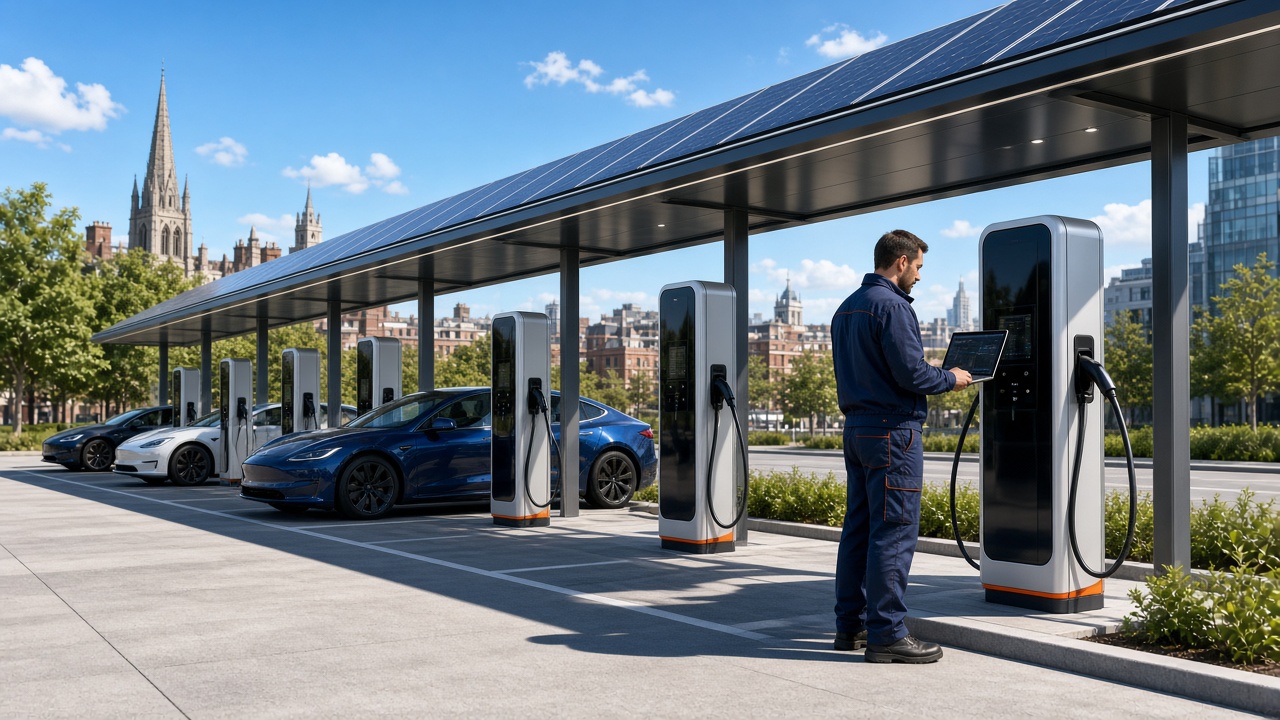
Commercial, public and rapid hubs. This is where the work gets bigger and more technical. Think 50kW to 350kW DC rapid chargers at motorway services, supermarket car parks, fleet depots and destination hubs, often with new transformers or substations, solar canopies and battery storage. Here you're working with three-phase distribution, large cables, groundworks coordination, load management systems and network connections. Commissioning a rapid charger means proving communications, payment, metering and the vehicle handshake as well as the electrical tests. Many installers start domestic and step up to this side as they gain experience.
Qualifications and the standards you need to know
Start with a full electrical qualification. EV charging is a specialism built on top of being a competent electrician, not a shortcut into the trade. That means a Level 3 electrical installation qualification (NVQ or equivalent), ideally with the AM2 and an ECS card. You'll also want inspection and testing skills, because commissioning and certification are central to every job.
Add a specialist EV qualification. You'll still see the older City & Guilds 2919 award on plenty of CVs and course listings. City & Guilds' current suite is the 2921 Electric Vehicle Charging series, aimed at qualified electricians and engineers who want to upskill:
- 2921-34: Level 3 Award in the design and installation of domestic and small commercial EV charging installations (replacing 2921-31 from 2024).
- 2921-32: design and quality assurance of large-scale EV charging installations.
- 2921-33: installation and maintenance of large-scale EV charging installations.
Other awarding bodies offer equivalent EV qualifications, and many training providers run them as short courses. Check that any course you book leads to a recognised qualification, and look into whether local funding is available.
Know the IET Code of Practice. The IET Code of Practice for Electric Vehicle Charging Equipment Installation, 5th Edition (2023) is the bible for this work. It covers domestic, on-street, commercial and industrial installs, the Smart Charging Regulations 2021, Part S of the Building Regulations, fire safety, vehicle-to-grid and DNO notification. Bear in mind that it was written to align with BS 7671:2018+A2:2022, so read it alongside the latest Wiring Regulations.
Get on top of BS 7671 Amendment 4. Section 722 of BS 7671 covers EV charging installations. According to SELECT's guide to Amendment 4, BS 7671:2018+A4:2026 was published on 15 April 2026. The previous version was withdrawn on 15 October 2026, so new installations must now comply with A4. For EV work, the key change is new Regulation 722.421.1.7.201. It clarifies that AFDDs are not required for circuits supplying EV charging equipment that conforms to the BS EN 61851 series and uses socket-outlets or vehicle connectors to BS EN IEC 62196-2. Regulation 551.7.1 has also been redrafted to require a suitable protective device where energy flow is bidirectional. That matters more and more as vehicle-to-home and vehicle-to-grid chargers arrive. The long-standing Section 722 requirements on PME earthing and DC fault protection still apply, so check your own copy of the regulations rather than relying on memory. We covered the wider changes in our BS 7671 Amendment 4 explainer.
OZEV authorisation and grants: still worth having
If you want to install chargers funded by government grants, you need to be an OZEV-authorised installer. The good news is that the grants are still running, but not for ever. OZEV's chargepoint grants guidance says the home and workplace grants have been "extended for a final year". Five schemes are available until 31 March 2027: up to £500 for renters and flat owners, up to £500 for households using cross-pavement solutions, up to £500 per socket for workplaces and landlords, and up to £2,000 per socket for state-funded schools. Asked in Parliament on 22 October what happens next, transport minister Simon Lightwood replied that the government would "make a further announcement on these grants in due course".
To become an authorised installer, your business needs membership of an accepted Competent Person Scheme (such as NICEIC, NAPIT or SELECT) or the ECA, plus bank and company details. Once authorised, you must only fit approved chargepoint models, test every install, notify the DNO, issue a BS 7671 certificate and keep records for three years. To stay on the list, you have to submit at least one claim every two years. Even if the grants end next spring, being authorised is a useful badge of credibility with customers.
What does an EV charge point installer earn?
Here's the honest picture from real, current data, not a made-up average.
- Live adverts: Reed's EV electrician listings, checked this week, show permanent EV electrician roles mostly between £35,000 and £47,500. Examples include £40,000 to £47,500 in Surrey and Kent, and up to £55,000 for a commercial EV role in Birmingham. Contract rates listed include £28 an hour for an EV electrician and £31 an hour for a working supervisor in Bedford.
- Specialist analysis: Recruiter Net Zero Evolution's analysis of live UK adverts in late September found EV installation and field service roles clustering at £38,000 to £45,000. Commissioning engineers advertised £40,000 to £60,000.
- Self-reported pay: Glassdoor puts average EV installer pay at £33,202, with a 25th to 75th percentile range of £26,040 to £42,495. That's based on 445 submissions, many of them older and including less experienced fitters, so treat it as a floor.
- The JIB baseline: From January 2027, a JIB Electrician on own-transport rates earns £20.44 an hour and an Approved Electrician £22.16, roughly £39,860 and £43,210 a year on basic. Our JIB pay rates 2027 guide has the detail.
My read: a qualified domestic EV installer in 2026 can realistically expect high-£30ks to mid-£40ks, often with a van and bonus. The real step up comes on the commercial and rapid side, especially commissioning, where experience of DC rapid units on live sites is scarce and pays accordingly. Self-employed installers set their own rates, but remember they carry their own costs, insurance and quiet months.
Why demand keeps growing
The structural drivers are strong. Under the ZEV mandate, 33% of a manufacturer's new car registrations must be zero emission in 2026, rising to 38% in 2027 and 80% by 2030. For vans, the figures are 24%, 34% and 70%. The government is reviewing the mandate's annual targets, with a consultation that closed on 23 October, but it says "the end goal hasn't changed". New petrol and diesel cars will still be phased out in 2030, and all new cars and vans must be zero emission by 2035. The same announcement noted that more than one in four new cars sold are now electric.
On public charging, the Department for Transport's official statistics counted 121,171 public chargers on 1 July 2026, including 28,887 rated rapid or above (50kW+). That's still only one public charger for every 17 battery EVs. The minister's October answer put the total at over 124,000 by 1 October, with the Local Electric Vehicle Infrastructure Fund expected to deliver more than 100,000 more near homes in England. The government has also committed £600 million for more charge points. Add the million-plus home and workplace chargers already fitted, ageing units that will need replacing, and the arrival of vehicle-to-grid, and that's a lot of future work.
How to break in: my practical steps
- Get fully qualified first. Level 3, AM2 and an ECS card. If you're not there yet, that's your priority.
- Take an EV qualification. A 2921-34 or equivalent course is a short, affordable upgrade. Then look at the large-scale awards if commercial work appeals.
- Buy and read the IET Code of Practice and A4. Knowing Section 722 inside out sets you apart in interviews.
- Join a CPS and get OZEV-authorised if you're running your own business.
- Get commissioning experience on DC units. If you can, join a charge point operator or a contractor building rapid hubs. That experience is gold.
- Use the tools. AI assistants such as Grok Bot, Claude or ChatGPT can help you prepare for a qualification, draft quotes or tailor your CV. Always check technical answers against BS 7671.
EV charging is the rare specialism that's busy now and set to get busier for a decade. I love that it combines proper electrical craft with cutting-edge kit. It's tech-forward, customer-facing and a great stepping stone into solar, batteries and smart energy.
Browse EV charging and electrician jobs across the UK and Europe and plug yourself into the transition.