What Does an OLE Technician Do? UK Rail Pay, Skills and Routes In
What UK overhead line technicians do, what they earn in 2026, how to get in, and why rail electrification demand looks solid for the next decade.
If you have ever stood on a platform at Euston, Waverley or Rugby and watched a Pendolino glide in without a puff of diesel, you have seen the work of an overhead line equipment technician. Nobody notices them when the job is done well, which is most of the time. But the 25,000 volt wire above your head, the masts, the droppers, the tensioning weights and the neutral sections are all maintained, faulted and renewed by a small, highly skilled group of people. In this instalment of our "what each role does" series, I want to look at the OLE technician: what the job actually involves, what it pays in 2026, how you get in, and why I think it is one of the most underrated electrical careers in the UK right now.
What an OLE technician actually does
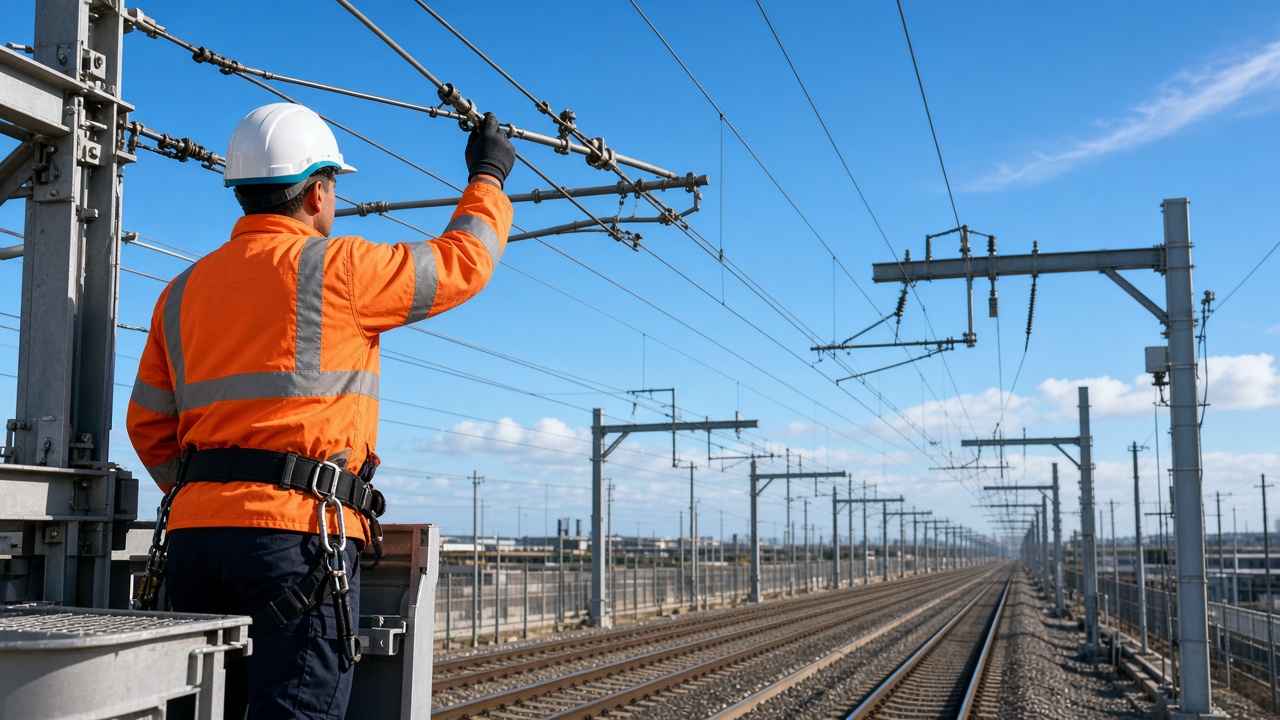
Overhead line equipment, usually shortened to OLE or OHLE, is the contact system that feeds traction power to electric trains through the pantograph on the roof. It is a mechanical system as much as an electrical one. The contact wire has to sit at the right height and stagger (the side to side zig zag that stops it wearing a groove in the pantograph), at the right tension, through curves, bridges, tunnels and junctions, in every kind of British weather.
Network Rail's own advert for a Technician (Overhead Line Equipment) at its Cheshunt depot sums it up neatly: "Working with high voltage systems you'll ensure our railway has the power to run the trains. Working at height is routine, and you'll use various types of specialist tools and equipment to measure, adjust, repair and modify cables and wires that keeps Britain's railway running."
In practice a typical week might include:
- Planned inspection and maintenance, checking wire height, stagger and wear, registration arms, insulators and earthing and bonding.
- Fault response, when a dewirement, a bird strike, a tree or a vandalised component takes a section out and trains stop.
- Renewals and modifications, replacing worn contact wire, droppers and fittings, often during overnight or weekend possessions.
- Supervising and checking, because technicians sit between the team leader and the operatives. The Network Rail job description lists making sure staff "have the appropriate and valid competencies", checking tools and plant are fit for use, and accurately recording what was and was not completed.
That last point matters. This is not a role where you simply turn up and pull wire. You are part of a safety critical system, and the paperwork, the isolations and the safe systems of work are as much the job as the spanners.
Why it is different from building services work
If you are coming from domestic or commercial installation, OLE will feel like a different world in a few ways.
First, the voltage. UK mainline electrification is mostly 25kV AC overhead, which is a long way from a 230V final circuit. You will not be working it live; you work under strict isolation and earthing procedures, and the discipline around that is absolute.
Second, the environment. You are trackside, often at night, frequently at height from road rail vehicles, mobile elevating work platforms or ladders, and you will need a Personal Track Safety (PTS) card under the industry Sentinel scheme before you set foot on the infrastructure. The HiringUK rail and infrastructure salary guide lists "PTS card (Sentinel), OLE competencies" as the tickets for OLE technician roles.
Third, the hours. Possessions happen when trains are not running, so nights, weekends and on call rotas come with the territory. Some people love that rhythm and the shift allowances that come with it. Others hate it. Be honest with yourself before you apply.
What OLE technicians earn in 2026
Pay in rail is refreshingly transparent compared with a lot of contracting work, because Network Rail publishes spot rates on its adverts.
- Network Rail's 2026 adverts for OLE technicians at Cheshunt and Rugby both list a spot rate of £38,482 for a permanent, full time role.
- HiringUK's 2026 survey of real UK adverts puts OLE technicians at £34,000 to £46,000 a year, or roughly £16.35 to £22.12 an hour on a 40 hour week.
- Glassdoor's data for overhead linesmen gives an average of around £38,249, with the 25th to 75th percentile running from about £30,800 to £48,869 and top earners above £60,000.
Remember that the base figure is only part of the story. Shift, night and on call payments, overtime on big possessions, and rail pensions can lift real take home pay well above the headline. If you are comparing an offer with a JIB graded role on a construction site, compare the whole package, not just the hourly rate. We covered the 2027 JIB rates here if you want a benchmark.
My honest read: on base pay alone, OLE technician roles sit roughly level with an experienced installation electrician. Where they pull ahead is stability, structured training, progression and pension. Those things compound over a career.
Why demand is solid for the next decade
Electrification has had a stop start history in Britain, and anyone who lived through cancelled schemes is entitled to be sceptical. But look at what is actually being spent and procured right now.
- In Scotland, Network Rail has advertised a Scotland's Railway Electrification Framework with an initial estimate of about £300m of work, a total framework value of £450m, and estimated dates from 1 March 2027 to 29 February 2032, with a possible extension to 2035. It covers overhead line electrification, traction power, power and distribution.
- In Fife, Network Rail recently closed sections of the Fife Circle from 10 to 27 October to deliver work that could otherwise have taken six months of weekend shutdowns, preparing the route for overhead wires. It is part of a £311.5m Scottish Government investment to electrify 118km of railway and introduce battery electric trains.
- In England, a recent Network Rail advert for an Electrification and Plant renewals lead in York mentions £160m allocated for the renewal of E&P assets across the North East, East Coast and East Midlands routes over the remaining three years of Control Period 7, with Control Period 8 work banks already being developed.
Then there is the simple maths of maintenance. Every kilometre of wire already up needs inspecting and renewing forever. Renewals do not get cancelled in a spending review the way a shiny new scheme can. That is the quiet strength of this career.
How to get in
There are three realistic routes.
1. Apprenticeship
Network Rail's Level 3 Rail Engineering Technician Apprenticeship runs for three years and pays £22,293 to start. Overhead Lines is one of the pathways, alongside Track, Signalling, Telecoms, Locking Fitter and Distribution and Plant. Applications for 2026 have closed, but you can register interest now for the 2027 intake. If you are 16 to 19, or helping a son or daughter decide, put a reminder in the calendar today.
2. Direct entry with transferable skills
Network Rail is explicit that it hires for "transferable skills and behaviours" and then trains people up to work safely and competently on the network. If you hold a Level 3 electrical qualification, have worked at height, and can show a strong safety record and the ability to lead a small team, you are a credible candidate even without rail experience.
3. Through a contractor
Electrification and renewals contractors working on Network Rail frameworks hire electricians too. One current example is a contractor recruiting Approved Electricians for HV renewals on the CP7 framework across Wessex, Kent and Sussex, asking for an Approved Electrician qualification, NVQ Level 3 and a full driving licence. It is not OLE itself, but it is a common side door into rail power, and many people move across disciplines once they have their PTS and possession experience.
Skills that will set you apart
From reading dozens of rail adverts, the people who progress fastest tend to have:
- A real safety mindset. Not just "I wear my PPE" but the ability to plan a safe system of work, brief a team and stop a job when something is wrong.
- Mechanical sense. OLE is about geometry, tension and wear. If you enjoy understanding why something is built the way it is, you will thrive.
- Data comfort. Measurement trains, digital inspection records and asset systems are now normal. Technicians who can read the data and spot a trend before it becomes a fault are gold.
- A clean driving licence. Depots cover long patches of railway, so this comes up again and again.
Where it leads
Technician is a launch pad, not a ceiling. Typical next steps include team leader, section manager, OLE design (Network Rail recruits Design Engineers for contact systems), project engineer, and Electrification and Plant engineering roles. The York advert mentioned above pays £55,596 to £67,813 for a lead portfolio manager in E&P renewals, which gives you a sense of where a career in rail power can go if you add project and commercial skills along the way.
My take
I think OLE is one of the best kept secrets in the UK electrical world. It combines high voltage, mechanical engineering, outdoor work and genuine public impact. Every successful possession means thousands of people get to work on Monday morning. The pay is solid, the training is structured, the frameworks are long, and the work cannot be offshored or automated away any time soon.
It is not for everyone. If you want a nine to five, or you hate heights, look elsewhere. But if you are a qualified electrician feeling a bit stuck in second fix and periodic inspections, or a school leaver who likes the idea of being paid to learn on Britain's biggest machine, it is well worth a serious look.
Practical next steps:
- Register interest in Network Rail's 2027 apprenticeship intake if you are starting out.
- If you are already qualified, search for OLE, E&P and Distribution and Plant technician roles and read the essential criteria carefully.
- Look into getting your PTS card through a Sentinel approved provider, or ask a prospective employer whether they fund it.
- Keep an eye on our latest electrical jobs, where rail and infrastructure roles appear regularly.
The railway is being rewired for the next fifty years. Somebody has to hang the wire. Why not you?