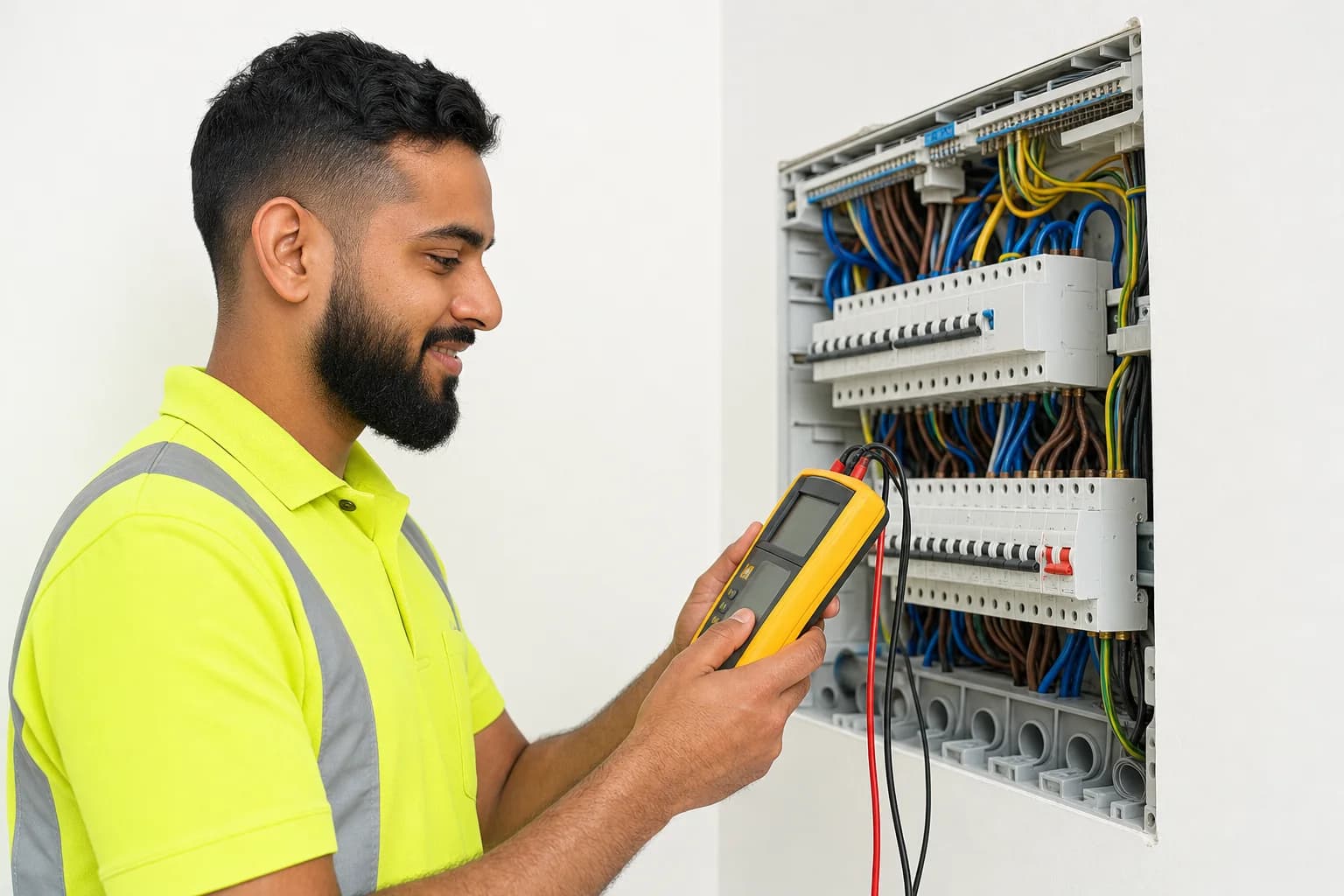
What does an EICR inspector do day to day?
You visit a property, isolate circuits where you can, and test the fixed wiring, consumer unit and accessories. You record readings and write up an Electrical Installation Condition Report. On a rented home, government guidance says the inspection looks for overloaded circuits, shock and fire risks, defective work, and missing earthing or bonding. Domestic days usually mean several flats or houses, often for letting agents and housing providers.
Every defect gets a code. C1 means danger is present and you may make it safe before you leave. C2 means potentially dangerous. C3 means improvement is recommended and does not make the report unsatisfactory. FI means further investigation is needed without delay. Getting these codes right matters, because the landlord's legal duty to carry out repairs depends on them.
Housing work versus commercial work
Housing work is high volume. You move between rented homes, fight for access, and write many short reports. A London domestic EICR tester advert posted in July 2025 listed £45,000 a year, with time and a half for evenings and Saturdays and paid call-outs. Some firms also expect you to fix faults you find.
Commercial fixed wire testing covers schools, hospitals, offices and shops, where boards are bigger and you often test out of hours. A Fareham advert from October 2025 offered £35,000 to £38,000 basic, plus a van and fuel card, with on-target earnings of £50,000. A Fife role listed a £39,000 base and average earnings near £52,350, with emergency lighting, fire alarm checks and thermal imaging added to the EICR work.
What qualifications do employers ask for?
City & Guilds offers three routes. 2391-50 covers initial verification of new work. 2391-51 covers periodic inspection, and is for people who already hold initial verification. 2391-52 combines both and is aimed at experienced electricians with no formal inspection qualification. Assessment is an online multiple-choice test plus a practical task. City & Guilds lists 31 August 2031 as the last date a certificate can be issued for the 2391 awards.
Adverts usually pair the 2391-52 or an equivalent with an NVQ Level 3 and the 18th Edition, plus a full driving licence. The Fareham commercial role wanted roughly three years of similar experience. If you want to supervise testing for a scheme-registered firm, the revised Electrotechnical Assessment Specification asks for an accepted qualification, at least two years of periodic inspection and testing experience, and ongoing CPD.
How compliance firms hire
Testing firms hire through agencies and through the government Find a Job service. Most pay a basic salary plus a bonus for each report or each job, which is why adverts quote on-target earnings well above basic. Expect a company van, a fuel card and travel time paid in some cases, and on-call rotas at firms that also do repairs.
Bring evidence. NICEIC advises firms to keep qualification certificates, completed EICRs going back two years or more, and CPD records ready for assessment. Keep copies of your own reports from day one. They prove your experience when you apply for senior tester or qualified supervisor roles.
Pay
GBP a year, before tax. Ranges run from the 25th to the 75th percentile, based on ONS Annual Survey of Hours and Earnings, April 2026 (provisional), moved to the current year with a wage index. Regional figures are modelled. Bonuses per report, overtime and on-call work push real earnings above basic. Refer to the Testing & Inspection salary guide for figures from live adverts.
What you need
- Level 3 electrical qualificationTesting adverts ask for an NVQ Level 3 or SVQ Level 3, or older City & Guilds 2330 or 2360 qualifications, so most testers start out as electricians.
- 18th Edition (BS 7671)An EICR assesses the installation against BS 7671, so employers want proof that you know the current wiring regulations.
- Inspection and testing awardCity & Guilds 2391-52 combines initial verification and periodic inspection. 2391-51 covers periodic inspection only and assumes you already hold initial verification.
- Two years' periodic testing experienceUnder the revised EAS, people carrying out or responsible for EICRs at certified firms need at least two years of periodic inspection and testing experience.
- Ongoing CPDThe EAS also requires testers and qualified supervisors at certified firms to keep up continuing professional development.
- Full UK driving licenceTesting is mobile work, and adverts commonly list a driving licence as essential.
Across the UK
| England | Private and social landlords must have the fixed installation tested by a qualified person at least every 5 years, give tenants the report within 28 days, and send repair confirmation within 28 days of finishing the work. Councils can fine up to £40,000. Social landlords must have the installation inspected and tested, and the electrical equipment they provide checked, by a qualified person before 1 November 2026. |
|---|---|
| Wales | Since 15 July 2022, the Renting Homes (Wales) Act has required periodic inspection and testing of all rented homes, social and private, every five years, or sooner if the last EICR said so. Contract-holders must get written confirmation of any remedial work. |
| Scotland | Private landlords need a competent person to carry out an EICR and PAT testing of landlord-supplied appliances before the first let and at least every five years. The Repairing Standard also requires 30 mA RCD protection in the main consumer unit. |
How to get there
- FirstQualify as an electricianFinish a Level 3 electrical qualification through an apprenticeship or adult route, and build experience on real installations.
- Before testingPass the 18th EditionGet the BS 7671 wiring regulations qualification, since every EICR measures the installation against it.
- Once experiencedTake the 2391-52Pass the combined initial verification and periodic inspection award: an online multiple-choice exam plus a practical task.
- After the 2391Join a testing firmStart on domestic or commercial EICRs, keep copies of every report and learn to code defects consistently.
- Two years onBuild two years of EICR historyTwo years of documented periodic testing plus CPD meets the EAS standard for testers and qualified supervisors at certified firms.
Open now on ElectricalRoles.co.uk


Questions people ask
Do I need to be an electrician to do EICRs?
In practice, yes. City & Guilds aims its 2391 awards at practising electricians, and testing adverts ask for a Level 3 electrical qualification and the 18th Edition alongside the 2391.
Which is better, 2391-51 or 2391-52?
2391-52 covers both initial verification and periodic inspection, and it is the one most adverts name. 2391-51 covers periodic inspection only and is meant for people who already hold an initial verification qualification.
How often do landlords need an EICR?
In England, Wales and Scotland it is at least every five years. In Wales the interval is shorter if the last EICR recommends it. Scottish landlords also need PAT testing of the appliances they supply.
What do the C1, C2, C3 and FI codes mean?
C1 means danger is present, and the inspector may make it safe on the spot. C2 means potentially dangerous, C3 means improvement recommended, and FI means further investigation is needed without delay. C3 items alone do not make a report unsatisfactory.
How long do landlords have to fix faults in England?
Remedial or investigative work must be completed within 28 days, or sooner if the report says so. The landlord then has 28 days to send the tenant and the council written confirmation from the qualified person who did the work.
Why do testing jobs quote on-target earnings?
Many compliance firms pay a basic salary plus bonuses linked to completed reports, overtime and on-call work. One 2025 Fife advert listed a £39,000 base and average earnings around £52,350 once those were added.
Sources
- GOV.UK: Electrical safety standards in the private and social rented sectors guidance
- City & Guilds: 2391 Initial and Periodic Electrical Inspection and Testing
- NICEIC: EAS changes to periodic inspection and testing competency requirements
- gov.scot: Repairing Standard statutory guidance, Annex D3 electricity
- NAPIT: New Welsh legislation on electrical safety checks
- Newport City Council: Renting Homes Wales Act
- Find a Job: Electrical Inspector, Commercial Test & Inspection (Fareham)
- Find a Job: Electrical / Domestic EICR Tester (London)
- Find a Job: Electrical / EICR Test Engineer (Fife)