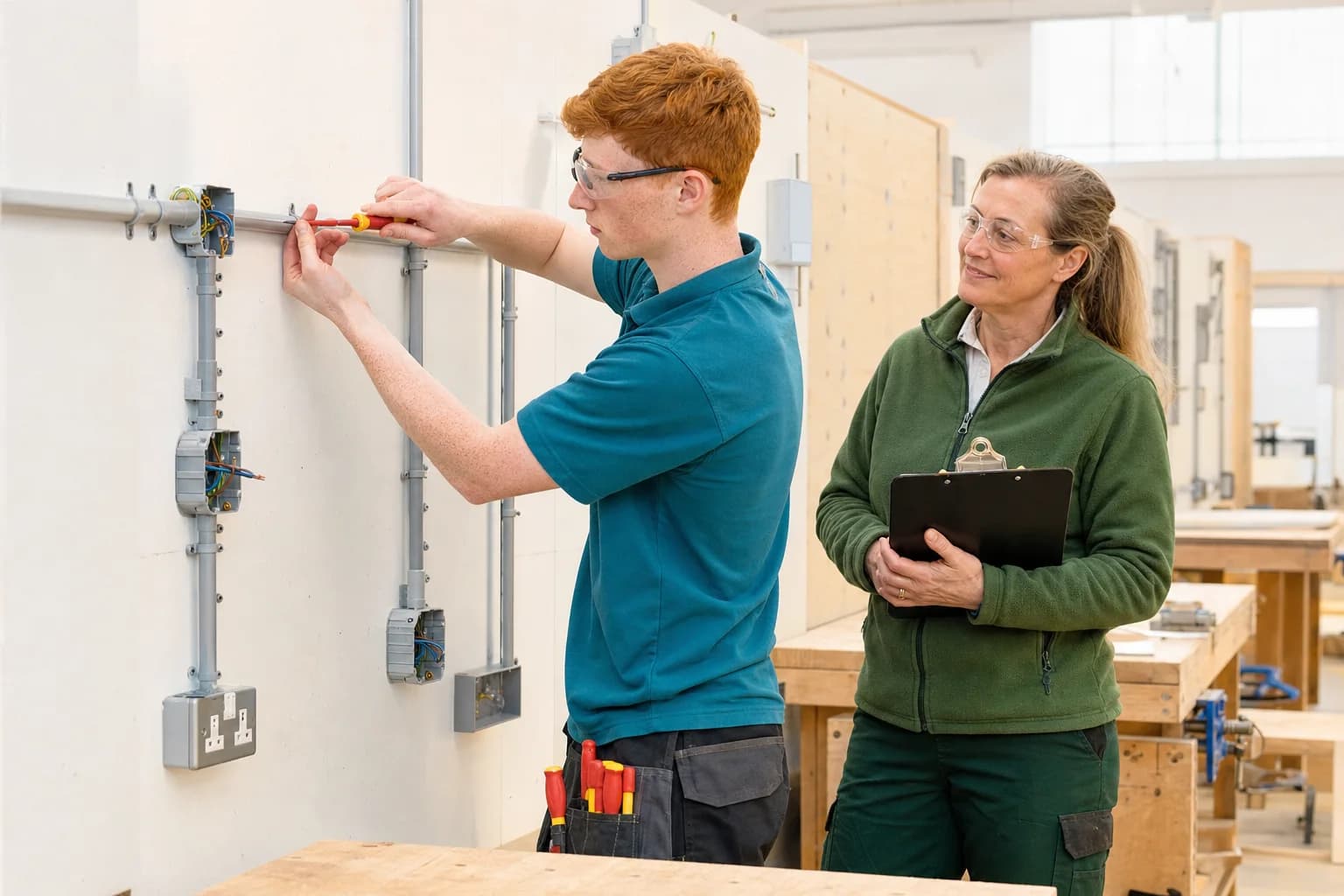
What the apprenticeship is
In England the route is the Installation and Maintenance Electrician apprenticeship, reference ST0152, published by Skills England. It is a Level 3 apprenticeship. It trains you to install, maintain and repair electrical systems in domestic, commercial and industrial buildings, working on low voltage systems under 1,000 volts. You're an employee from day one, so you earn a wage and get holiday pay. Most of your time is spent on site with your employer, learning from an experienced electrician who mentors you.
The qualification you work towards is the Level 3 Electrotechnical Qualification. JTL uses EAL as its awarding body. Since the September 2023 update the standard also covers newer kit such as EV chargers, solar PV and battery storage. Version 1.2 has applied since 21 July 2025. Skills England lists a revised assessment plan that is due to take effect from 17 December 2026, so if you start around then, check which version your training provider is using.
How the training is split between site and classroom
The classroom side is either day release or block release, depending on your centre. With JTL, you go to one of its own training centres or a partner college near you, usually on day release across the academic year. Some regions run block release instead. A JTL training officer is assigned to you and keeps track of your progress through the whole apprenticeship.
The knowledge units run in a set order. You start with health and safety and electrical science. Then you move on to terminations and connections, planning and overseeing work, design and installation, inspection and testing, fault finding and the BS 7671 wiring regulations. Practice for the final assessment is built into the course from the start. You don't leave it all to the last few months.
How long it takes and how it ends
Expect about four years. When the standard was first approved in 2015, it said a typical completion time was 48 months and that a newcomer was unlikely to finish in under 42. If you already hold relevant qualifications or experience, your provider can shorten the programme.
The apprenticeship finishes with an end-point assessment called the AM2S, usually taken in year four. It's a practical assessment of whether you can do the job to the standard of a qualified electrician. Once you pass, you can apply for the ECS gold card, which shows you're a fully qualified electrician who can work on your own. From there, people move into supervision, estimating, design, project management or run their own business.
How to find an apprenticeship
You need an employer before you can start, but JTL lets you apply first and look for an employer while your application goes through. Its process has several steps. You fill in an online form and upload ID. You sit initial assessments in English and maths and have a phone interview. You also need a colour vision certificate from an optician. Employers also advertise directly on the government's Find an apprenticeship service.
You can apply while you're still at school. You can't start until after the last Friday in June of the school year in which you turn 16. JTL puts the full training cost at £23,000, but the apprentice pays nothing except travel to and from the employer's workplace. In England you also need to meet the residency rules, which usually mean three years' ordinary residence in the UK before you start.
Pay
GBP a year, before tax. JIB figures are the official National Standard Rates for apprentices at work from 5 January 2026, worked out at 37.5 hours over 52 weeks. They are due to rise 2% in January 2027. The UK range is modelled from ONS ASHE April 2026 provisional data. Your age matters: from your second year, an apprentice aged 19 or over must get at least the National Minimum Wage for their age (£12.71 an hour at 21 and over), which is more than the JIB Stage 2 rate. Refer to the Apprentices & Trainees salary guide for figures from live adverts.
What you need
- English and mathsJTL asks for Level 2 in both: GCSE grade 4 or above, Level 2 Functional Skills, or a pass in its supervised assessment. If you're 16 to 18 when you start and don't have Level 2, you still have to get it before you finish.
- AgeYou can apply while still at school. You can start after the last Friday in June of the school year in which you turn 16.
- An employerYou must have an employer before you start. Some providers, including JTL, let you apply before you've found one.
- Colour visionJTL needs colour vision evidence from an optician for electrical applicants. It says colour-blind applicants are unlikely to be accepted, for safety reasons.
- Right to work and residencyFor a government-funded apprenticeship in England you need the right to work. You'll usually also need three years' ordinary residence in the UK before you start, unless your immigration status exempts you.
- ID and prior qualificationsExpect to upload photo ID and a passport-style photo, and to show evidence of any earlier qualifications.
Across the UK
| England | Apprentices follow the Skills England Level 3 Installation and Maintenance Electrician standard (ST0152), with the AM2S end-point assessment. |
|---|---|
| Wales | JTL runs a separate electrician apprenticeship for Wales, funded by the Welsh Government. Its funding and entry rules are different from England's. |
| Scotland | Scotland has its own Modern Apprenticeship in Electrical Installation at SCQF level 7, run under the Scottish electrical training scheme. |
| Northern Ireland | Northern Ireland uses its own Electrotechnical Level 3 apprenticeship framework, set out on nidirect. |
How to get there
- Before startingApply and pass the checksApply to a provider such as JTL or to an employer advertising on Find an apprenticeship. Sit the English and maths assessments and get a colour vision certificate.
- Month 0Secure an employer and startSign on as an employee. Your provider arranges a training centre or partner college near you.
- Years 1-3Learn on site and at collegeWork alongside qualified electricians and attend day or block release. Units run from health and safety and electrical science through to design, installation and BS 7671.
- Years 3-4Testing, fault finding and AM2S preparationCover inspection, testing, commissioning and fault diagnosis, and build up the practical skills you'll need for the end-point assessment.
- Year 4Pass the AM2STake the practical end-point assessment that confirms you work to the standard of a qualified electrician.
- After completionApply for the ECS gold cardOnce qualified, apply for the gold card and take electrician roles where you work on your own.
Open now on ElectricalRoles.co.uk


Questions people ask
Can I start an electrical apprenticeship without a GCSE in maths or English?
Yes, if you pass a supervised assessment at the required level. JTL accepts this in place of a certificate. If you're 16 to 18 when you start, you'll have to get the qualification before you finish. Since 11 February 2025 it has been optional for apprentices aged 19 and over at the start.
Do I have to pay for the training?
No. JTL puts the full cost of the electrical apprenticeship at £23,000. The apprentice pays nothing except the cost of getting to and from the employer's workplace.
How much will I earn as an apprentice electrician?
From April 2026 the legal minimum is £8 an hour while you're under 19 or in your first year. JIB rates for 2026 run from £8.16 an hour at Stage 1 to £14.03 at Stage 4. If you're 19 or over and past your first year, you must get at least the full minimum wage for your age, which is £12.71 an hour at 21 and over.
Can I do an electrical apprenticeship if I am colour blind?
It's unlikely. JTL asks every electrical applicant for colour vision evidence from an optician. It says colour-blind applicants are unlikely to be accepted, because wires are identified by colour and mixing them up is a safety risk.
What is the AM2S?
The AM2S is the practical end-point assessment that finishes the Installation and Maintenance Electrician apprenticeship in England. It's usually taken in year four, and training providers build preparation for it into the course from the start.
Can I apply before I find an employer?
Yes, with providers such as JTL. You can apply first and look for an employer while the application goes through, but you can't start the apprenticeship until you have one.